Meaning at a glance
Documented history shows the rose motif has appeared in many decorative traditions; later popular meanings grew from those contexts and modern wearers often add personal symbolism—this article separates museum-backed evidence from later interpretations and offers practical buying and gifting advice.
Quick answer
Rose jewelry meaning combines a long documented history as a decorative and symbolic motif with later, varied associations of love, secrecy, beauty, and memory. The authoritative goal is to explain the documented history and changing contexts of the rose motif, separate cultural or religious evidence from later popular interpretations, and give practical guidance for choosing and wearing rose jewelry in the present day.
What the historical evidence shows
Museum scholarship records the rose as a decorative or symbolic motif across many periods and places rather than a single universal symbol. The Victoria and Albert Museum (V&A) places the rose within broad jewelry histories and changing social meanings, noting that floral motifs recur in different techniques and materials as tastes and technologies evolve. That museum evidence shows the motif appears in engraved gems, metalwork, and enamels of varied eras and that jewellers adapted the rose to prevailing fashions.
Across cultures the rose’s presence in decorative arts does not always carry the same symbolic content. For example, some European jewelry of the late medieval and Renaissance periods used floral imagery in devotional and courtly contexts, while later Georgian and Victorian jewelry used botanical motifs to convey sentimentality within a changing market for personal ornament. The V&A documents how these stylistic and social shifts affected what motifs meant to wearers and viewers at the time.
The V&A’s overview of gemstones also explains how particular stones came to be associated with flowers in jewelry through cutting, setting, and color choices. Historical uses of colored gemstones to imitate petals or to create centerpieces for floral designs are part of that technical record rather than an interpretation about the flower’s meaning itself.
Separating documented historical meanings from modern interpretations
Documented historical meanings come from the contexts in which objects were made and used, as recorded by museums and archival sources. The V&A’s work emphasizes that what craftsmen and clients intended can often be read through materials, inscriptions, portraits, and provenance. For many historical pieces the rose appears alongside other symbols that clarify intent—mourning jewelry, court portraiture, or devotional items, for instance—so the object’s social context matters.
Modern personal interpretations—such as wearing a rose pendant to declare romantic love, to symbolize self-care, or as a fashion association with a subculture—are contemporary layers of meaning that individuals and cultures have added long after an object’s manufacture. These modern meanings are valid as personal symbolism but are not the same as the documented reasons a historical object carried its imagery. The rose motif’s popularity in late 19th- and early 20th-century sentimental jewelry, for example, underpins some present-day associations of romance, but those associations evolved and were not universally fixed.
How the rose motif, gemstones, and traditions appear in jewelry
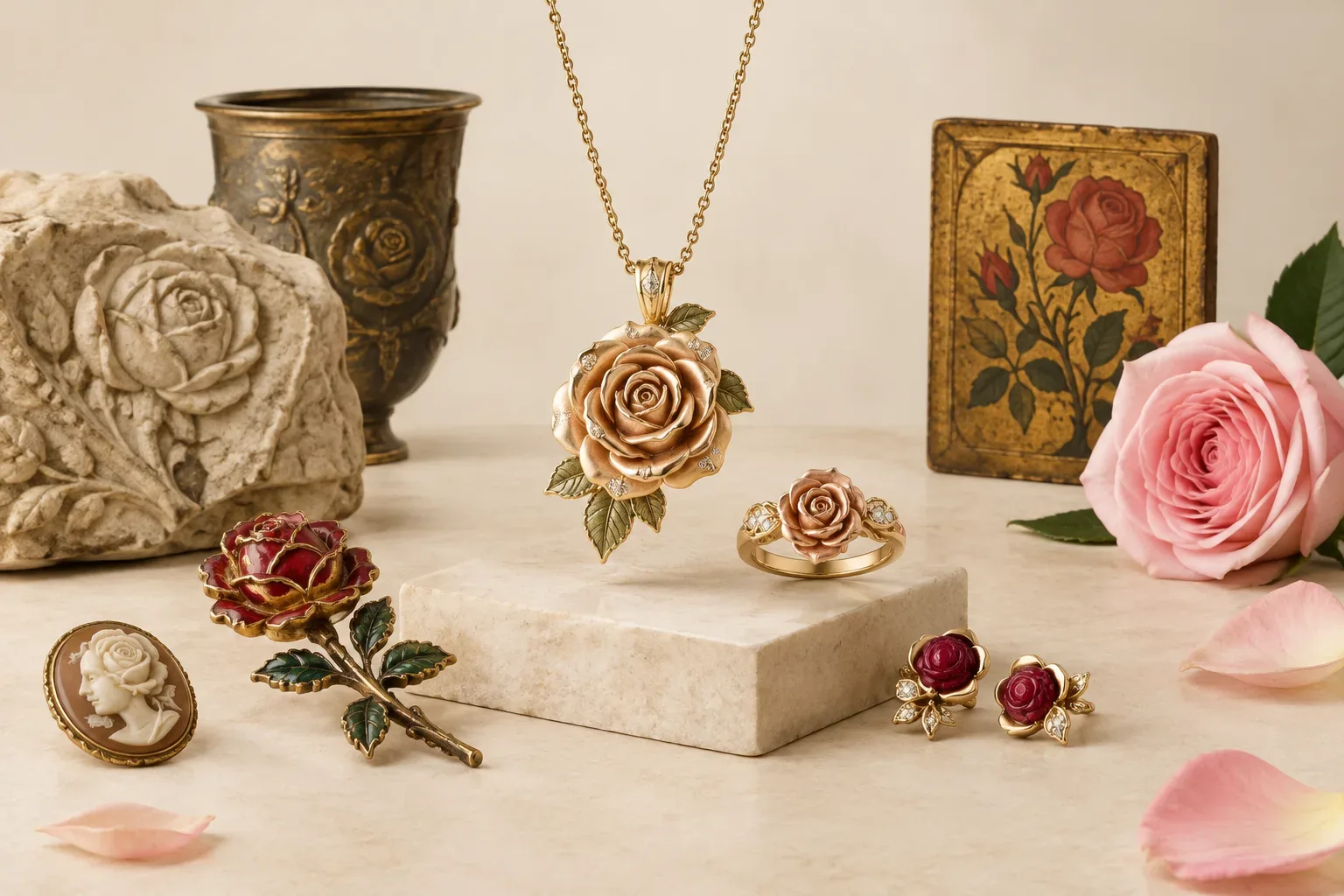
In material terms, jewellers have represented roses in multiple ways: as engraved or repoussé metalwork, as carved gems or cameos, as enamelled petals, and as settings where colored stones form petals around a central gem. The V&A notes that motifs follow available techniques and materials, so a goldsmith in one era might produce a small, highly detailed rose in gold and enamel, while another period’s jeweller might imply the flower with a cluster of garnets or rubies.
Gemstones are chosen to suggest colour or central focus. Red stones such as garnet and ruby, and pink-tourmaline varieties, are commonly used where artisans want to evoke a rose’s colour; pearls and diamonds are used to suggest dew, light, or to lift a design toward formality. The V&A’s A–Z of Gemstones explains historical uses and identifications of those materials and how cutting and setting choices affect a gemstone’s role in the motif.
Traditional jewelry types that feature roses include brooches, pendants, lockets, rings, and hair ornaments. Lockets and brooches that combine a rose motif with space for a miniature or hairwork historically linked the image to memory and sentiment. In contemporary design, the rose is also common in minimalist outlines, sculptural three-dimensional interpretations, and in mixed-media pieces that reference historical forms while using modern production techniques.
Practical guidance for choosing or gifting rose jewelry
Start with context: consider the recipient’s style, cultural background, and the occasion. A detailed, historically inspired rose locket may be appropriate for someone who values vintage aesthetics or family memory, while a small rose stud or a simple rose-etched band suits everyday wearers. Avoid assuming that the rose carries the same personal meaning for every person; ask or select a neutral framing—such as beauty or admiration—if you are uncertain.
Materials and stone choices affect both appearance and long-term care. If colour is important, ask about the gemstone identity and treatments. The Federal Trade Commission (FTC) advises consumers to expect clear disclosure about gemstone treatments, imitations, and whether a piece contains synthetic or enhanced stones. For heirloom or long-wear pieces, prioritise durable settings and metals appropriate to the wearer’s lifestyle.
If you want the gift to carry a specific message, include a short note that explains your intention. Because modern meanings vary, placing words alongside the object is the clearest way to communicate sentiment without relying on assumed historical symbolism. For formal gifts such as engagement rings, consider established conventions (for example, diamond engagement rings in many Western markets) together with the rose motif—either as a decorative accent or as the central theme—so the piece balances personal symbolism with practicality.
Price transparency and authenticity matter. Ask about hallmarks, metal testing, and gemstone certificates when applicable, and prefer reputable dealers who provide written information about materials and returns. The FTC’s consumer guidance is a useful reference for understanding what sellers should disclose about gemstones, diamonds, and pearls.
Care, authenticity, and ethical considerations
Care for rose jewelry follows ordinary rules for the materials involved: clean and inspect settings, avoid harsh chemicals on delicate enamel or certain gems, and store pieces to prevent scratching. Complex constructions—engineered petals, enamel, and pavé settings—require gentle handling and periodic professional checks.
On authenticity and disclosure, the FTC expects sellers to reveal treatments and imitations. Ask whether colored stones are natural, heat-treated, dyed, lab-grown, or simulants. For historically styled pieces, confirm whether a piece is genuinely antique, a period revival, or a modern design inspired by historical forms. Clear provenance or documentation improves the value and meaning of the gift.
Wearing meanings today
Contemporary wearers combine historical echoes and personal meanings. Some choose rose jewelry because of romantic connotations rooted in later Western sentimental traditions; others select it purely for botanical beauty or as a family heirloom. Designers also use the motif to reference cultural or archival forms, which can be meaningful to wearers who appreciate that connection.
Because meanings are layered and personal, the most respectful approach—whether choosing for yourself or gifting to someone else—is to treat historical associations as informative rather than prescriptive, and to allow the wearer’s own context and intentions to complete the piece’s meaning.
Frequently asked questions
Does a rose motif always mean romantic love?
No. While later Western sentimental traditions often associate roses with romantic love, museums show the motif has served decorative, devotional, commemorative, and courtly functions in different contexts. Modern wearers may ascribe romantic meaning, but that is a later and culturally specific interpretation.
Which gemstones are traditionally used to represent roses in jewelry?
Gemstones that suggest red or pink—such as ruby, garnet, and pink tourmaline—have commonly been used to evoke a rose’s color, while pearls and diamonds are sometimes used for contrast or to suggest light or dew. The Victoria and Albert Museum’s resources explain how gem selection and cutting support design choices.
How can I verify if a rose-themed piece is an antique or a modern reproduction?
Ask the seller for provenance, hallmarks, and any documentation. Request details about maker’s marks, metal testing, and whether any stones are modern replacements. Reputable dealers will provide clear information; the FTC advises transparency about treatments and imitations.
Is rose jewelry appropriate for men?
Yes. Floral motifs have appeared in men’s jewellery historically and in contemporary design. Choice should reflect the wearer’s style and the cultural context rather than assumptions about gender.
How should I care for delicate rose pendants with enamel or pavé settings?
Treat enamel and pavé settings gently: avoid household chemicals, remove before strenuous activity, and store separately to prevent abrasion. Have complex settings inspected periodically by a qualified jeweller.
If I want the gift to carry a specific meaning, what is the best approach?
Include a short written note that explains your intended message. Because historical symbolism varies and modern meanings are personal, words alongside the object ensure your meaning is received as intended.
Sources and further reading
- Bedazzled: A History of Jewellery — Victoria and Albert Museum
- An A-Z of Gemstones — Victoria and Albert Museum
- Buying Gemstones, Diamonds, and Pearls — Federal Trade Commission