Meaning at a glance
Explain the documented history and changing contexts of the lantern motif, separate cultural or religious evidence from later popular interpretations, and give practical guidance for choosing and wearing the motif in modern jewelry.
What the historical record actually shows
When you look for documented historical meanings attached to specific decorative motifs, reliable museum scholarship is cautious about asserting universal symbolism. The Victoria and Albert Museum (V&A) frames the history of jewellery as a record of changing social contexts and fashions rather than a catalog of fixed symbolic meanings. That means the presence of a motif in an object does not always carry a single, stable message; its meaning can depend on who made it, who wore it, and when.
For example, the V&A's survey of jewellery history indicates that motifs migrated between decorative arts, costume, and personal adornment as tastes and technologies changed. This broader pattern applies to motifs that resemble lanterns: designers sometimes borrowed forms associated with domestic or public lighting, theatrical props, decorative ceramics, textiles, or folk craft. However, the museum’s public-facing materials do not present a definitive, widely documented symbolic language that assigns a single historical meaning to lantern imagery across cultures and eras.
Cultures and periods: what can and cannot be claimed from museum evidence
The best-supported historical claims are about style and context rather than universal symbolism. V&A collections and interpretation identify recognizable periods and practices—such as the jewellery fashions of the 19th and early 20th centuries—where novelty motifs and small sculptural forms became popular in Western dress jewellery. In those contexts, miniature objects, architectural forms, and novelty pendants could include lamp- or lantern-like shapes as part of broader decorative trends.
What the V&A materials do not support are blanket statements that a single culture or period consistently used lanterns in jewellery to mean the same thing everywhere. Where lantern imagery appears in different cultural arts and festivals, the meanings are specific to those traditions and need to be documented from the relevant cultural or religious sources rather than inferred from Western jewellery trend books. In short: museum evidence supports statements about changing styles and materials and about the movement of motifs across decorative media, but it does not provide a single historic ‘‘lantern jewellery meaning’’ that applies universally.
Documented historical uses versus modern personal interpretations
Documented historical uses: Museum sources like the V&A emphasise the material and contextual record—what pieces were made, what materials and techniques were used, and how jewellery signalled status, mourning, or sentiment depending on era and culture. Where lantern-like forms were incorporated into jewellery, the documentation tends to record form, technique and context (for example, novelty pendants in the 19th century) rather than a universally agreed symbolic dictionary attributing spiritual or moral messages to that motif alone.
Modern personal and commercial interpretations: In contemporary practice, people commonly ascribe meanings to lantern imagery that are personal, seasonal, or culturally specific. Popular modern associations include guidance and hope (light in darkness), commemoration (lanterns used in memorial rituals), celebration (festival lanterns and gatherings), and illumination of knowledge or inner life. These contemporary meanings arise from current cultural practices, festival imagery, and marketing, and should be treated as valid personal or cultural interpretations rather than archaeological or museum-confirmed historical facts.
How the lantern motif, gemstones, and traditions appear in jewelry
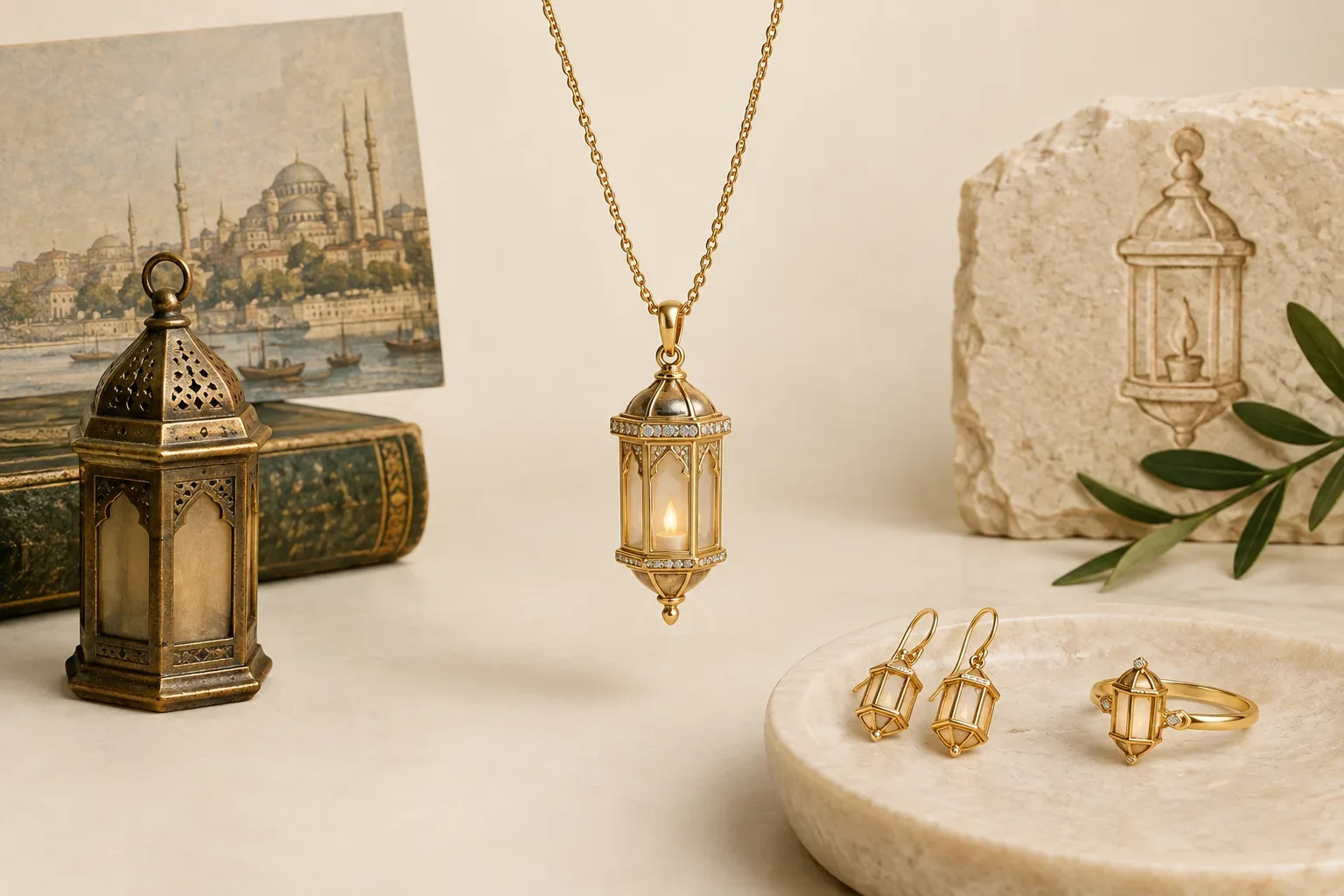
Form and technique: Jewelers translate the lantern motif into wearable pieces in several practical ways. Common approaches include small pendant charms shaped like lanterns, openwork metal cages that suggest a lattice or windowed lantern, miniature enclosed lockets that hold a small flame-like bead or colored glass, and engraved or enamelled surfaces that depict lanterns in two dimensions. Metalwork techniques such as filigree, pierced metal, and enamel are often used to suggest the light-and-shadow effect associated with lanterns.
Gemstones and glass: When artisans want to represent the idea of a flame or glowing light, they often use translucent or reflective materials. According to the V&A’s guidance on gemstones and historical uses, gemstones and coloured glass have been used traditionally to simulate light effects and to provide focal points in jewellery. Contemporary makers may choose citrine, yellow sapphire, amber, fire opal, topaz, or simply faceted glass or crystal to suggest warmth and glow. The particular stone chosen is usually a matter of aesthetic preference, affordability, and the cultural associations the giver or wearer prefers.
Tradition and technique crossover: Lantern imagery also turns up in pieces that reference other traditions—festival jewellery produced for cultural events, souvenir pieces that evoke travel and place, and commemorative items made for memorial or community rituals. As with other motifs, the way a lantern motif is realised reflects the maker’s skills, available materials, and intended audience rather than a single symbolic prescription.
Practical and respectful guidance for choosing or gifting lantern jewelry
Respect cultural context: Before selecting a lantern-themed piece as a gift, consider whether the motif has a specific cultural or religious significance for the recipient. Lanterns are meaningful in many living traditions—festivals, memorial practices, or religious ceremonies—and assuming a single meaning risks being insensitive. If you are unsure, ask respectfully or choose a neutral expression of the motif that emphasizes light or guidance rather than a specific ritual form.
Choose materials thoughtfully and check disclosures: If you are buying gemstones or a piece of fine jewellery, rely on vendors who clearly disclose gemstone treatments, imitations, and metal fineness. The United States Federal Trade Commission provides consumer guidance on buying gemstones, diamonds, and pearls and advises that sellers should disclose treatments and imitations. Prioritise reputable sellers and ask for written details about stones and metal content when value or authenticity matters.
Consider scale, wearability and meaning: Lantern motifs can be novelty-sized or very subtle. Think about how the recipient dresses and whether they prefer statement pieces or discreet jewellery. For someone who values symbolic meaning, include a short note explaining why you chose the motif—whether it stands for guidance, remembrance, celebration, or simply a shared love of light-inspired design.
Respect craftsmanship and longevity: If your gift is intended as a keepsake, look for quality in construction—secure bails and clasps, solid settings for any stones, and finishes that suit everyday wear or occasional use. If the piece contains enamel or fine filigree, advise the recipient about gentle care to avoid damage. Finally, if the piece is handcrafted or sourced from a particular cultural artisan community, honour that provenance by asking about maker background and, where appropriate, paying fair prices that respect craft traditions.
Final takeaways
Lantern jewellery meaning is not a single, historically documented symbol that applies everywhere. Museum scholarship, as represented by the Victoria and Albert Museum, shows that jewellery motifs change meaning with time, place, and social context. Modern associations—light, guidance, remembrance, or festivity—are widely used today but are contemporary interpretations rather than universal historical facts. Choose and gift lantern jewellery with awareness of the recipient’s cultural context, attention to materials and disclosure, and a clear personal note about the meaning you intend.
Frequently asked questions
Is there a single historical meaning for lantern jewelry?
No. Museum scholarship, such as materials from the Victoria and Albert Museum, indicates that motifs change meaning with context and fashion; there is no single universally documented historical meaning for the lantern motif in jewellery.
What do modern wearers usually mean when they wear lantern-themed jewelry?
Contemporary wearers commonly interpret lantern imagery as representing guidance, hope, remembrance, celebration, or illumination. These are modern, personal, or cultural interpretations rather than museum-confirmed historical facts.
How should I check the authenticity of gemstones in a lantern pendant?
Ask the seller for written disclosure about gemstone identity, treatments, and imitations. The Federal Trade Commission advises consumers to request clear information about treatments and imitations when buying gemstones, diamonds, or pearls.
Is it respectful to gift lantern jewelry tied to a cultural festival?
It can be, but consider the recipient’s relationship to that cultural practice. If the motif has specific ritual or religious significance, ask or choose a neutral design. A brief note explaining your intention and respecting the tradition is often appreciated.
What materials best suggest a lantern’s ‘glow’ in jewellery?
Designers often use translucent or reflective materials—such as faceted crystal, coloured glass, citrine, topaz or warm-toned gemstones—to suggest a flame’s glow. The V&A’s guidance on gemstones explains how different stones have been used historically for colour and effect.
Sources and further reading
- Bedazzled: A History of Jewellery — Victoria and Albert Museum
- An A-Z of Gemstones — Victoria and Albert Museum
- Buying Gemstones, Diamonds, and Pearls — Federal Trade Commission