Meaning at a glance
Documented evidence shows the circle has been used across many jewellery traditions for structural, decorative, and commemorative purposes; later religious and popular meanings developed in specific contexts. This article distinguishes what is recorded by museum scholarship from modern personal and commercial interpretations, explains how the motif appears in forms and settings, and offers respectful, practical guidance for selecting and gifting circular jewellery.
What the historical record shows (by culture and period)
Museum scholarship emphasizes that circular forms are one of the oldest and most persistent decorative devices in jewellery because the shape suits metalworking techniques, wearable proportions, and gem cutting. The Victoria and Albert Museum's overview of jewellery history highlights how makers across different periods reused simple geometric forms to meet changing tastes and technologies rather than to express a single, unchanging idea.
In the ancient Mediterranean and Near Eastern contexts, circular motifs appear in bracelets, torque ends, disc-shaped amulets and coin pendants; the form functions both as ornament and as a mounting for inscriptions or images. The V&A presents these examples as part of a broader material history rather than assigning a single symbolic meaning to the circle across all objects.
In medieval and early modern European jewellery collections, circles are common in finger rings, round reliquary pendants and disc brooches. Museums interpret these as practical developments—rings for signet use, round reliquaries to contain relics, and circular brooches for fastening garments—while decorative motifs could include geometric, vegetal or figurative patterns worked into the round field, according to the V&A's history of jewellery.
In Asian jewellery traditions, circular elements appear in ways that depend on regional techniques and customs: discs and round beads are important in South Asian bead stringing and in East Asian metalwork and enamel. The V&A's survey treats these examples as culturally specific practices and techniques rather than a single shared symbolism.
Across these periods and places, museum documentation emphasizes craft, function and local meaning more than a universal symbolic message for the circle. That is, the historic record preserved in collections and catalogues usually links form to use, technology and context rather than to one global symbolic interpretation, a point stressed by the Victoria and Albert Museum's materials on jewellery history.
Documented meanings versus later or popular interpretations
When reading about ‘circle symbolism’ it is important to keep two levels separate: what historical objects and archives actually show about use, and what later writers, religious groups or retailers have proposed as symbolic meaning. Museums typically present primary evidence and context; modern symbolic readings often layer newer ideas on top of that evidence.
For example, historical jewellery may use a circular frame simply to hold a pictorial scene, a relic or a gemstone. That practical choice can be read later as 'eternity' or 'wholeness' in popular language, but those broader meanings are frequently modern interpretations applied retrospectively rather than documented beliefs from the object's makers or original owners. The Victoria and Albert Museum’s work on jewellery history highlights the importance of context when interpreting form and motif.
Religious and cultural communities sometimes developed specific symbolic uses for circles in particular contexts. Where that is documented, museum notes and catalogues will usually identify the cultural practice and its recorded meaning. Where there is no direct documentary link, claims about universal or ancient symbolic intent should be treated as contemporary interpretations.
How the circle motif appears in modern jewelry: motifs, gemstones, and traditions
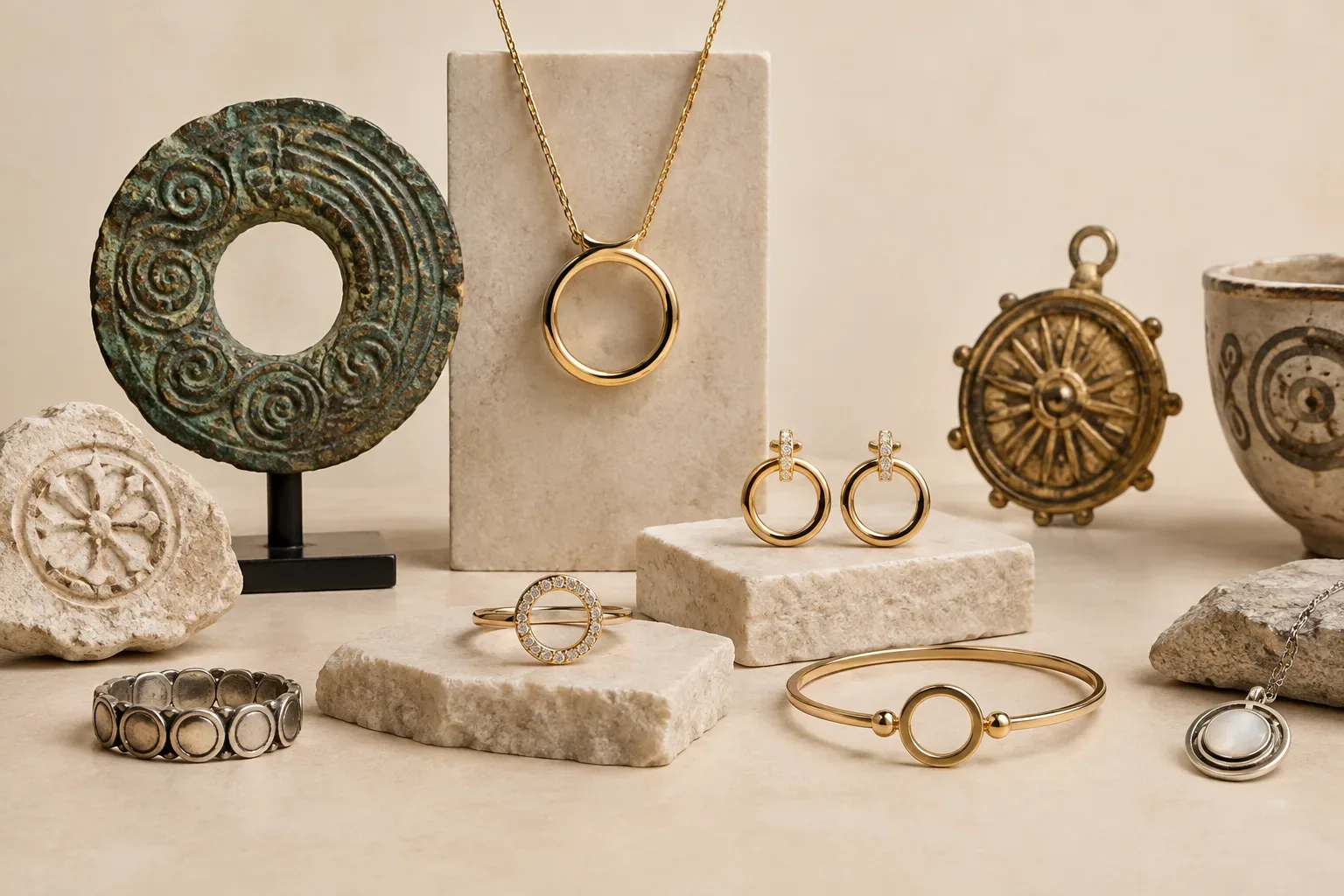
In contemporary jewellery the circle appears in many familiar wearable forms: round signet and decorative rings, hoop earrings, pendant discs and medallion lockets, circular cluster settings, halo settings around a central stone, and strands of round beads or pearls. The shape is also used as a repeated motif in chain links, bangles and metalwork patterns.
Gemstone choice and cut interact with the circle motif. The round brilliant cut is the most common faceted cut for diamonds and many gemstones because it maximizes sparkle in a circular outline; cabochons and pearls are frequently used in circular settings to preserve smooth round surfaces. The Victoria and Albert Museum’s A–Z of Gemstones provides context on how different stones and cuts have been used in decorative and historical jewellery.
Traditional forms that use circles include lockets, where a round case protects a miniature or photograph; mourning jewellery, which historically sometimes used round medallions; and coin pendants that mount a circular currency piece. Modern designers also use the circle as a minimal graphic statement or as a base for engraving names, dates or motifs.
For care and materials, basic consumer protection and disclosure principles apply: in the sale of gemstones, treatments, enhancements and imitations should be disclosed to buyers. The U.S. Federal Trade Commission’s guidance on buying gemstones, diamonds and pearls explains that sellers should tell consumers about treatments, significant enhancements and whether a material is an imitation. That disclosure matters whether you’re buying a simple circular pendant or a round-cut diamond set in a halo.
Choosing and gifting circle jewelry: practical, respectful guidance
Decide first what kind of meaning you want the piece to carry. If you are choosing a symbol for a personal milestone, an anniversary or a memorial, consider whether the recipient is likely to value historical precedent, a contemporary symbolic reading (for example 'eternity' or 'completion') or simply attractive design. When meaning is important to the giver and receiver, use the conversation to confirm the desired message rather than assuming universal symbolism.
Be culturally respectful. If a circular form is part of a distinct cultural or religious object in a living community, take care not to treat that form as a decorative costume. Research the item or, better, speak with someone from the culture about appropriate use. For gift-giving occasions where cultural sensitivity matters, choose designs that acknowledge provenance or opt for neutral geometric forms without sacred iconography.
Prioritize fit and wearability. Rings require accurate sizing; bracelets and necklaces need appropriate length. Consider the recipient’s lifestyle—hoop earrings vary in diameter and closure style and can be impractical for some jobs; a small pendant may be more wearable daily. If you are uncertain, choose a design that can be easily resized or returned.
Think about materials, authenticity and disclosure. If a round gemstone or pearl is the focal point, ask the seller about the stone’s treatment, country of origin and whether it is natural, synthetic or an imitation. The Federal Trade Commission advises consumers to expect honest disclosure about treatments and imitations when buying gemstones and pearls. For budget, consider lab-grown alternatives or treated stones with clear labeling, and keep receipts and certification if available.
Personalize thoughtfully. Engraving a date, initials or a short phrase inside a circular locket or on the reverse of a pendant can make a generic circle meaningful to the wearer. When engraving a symbolic word like 'eternity' or 'wholeness', remember that such wording conveys a modern interpretive layer rather than a documented historical fact about the motif.
Finally, consider provenance and maker information. Purchasing from reputable workshops, galleries or dealers that document materials and techniques supports both ethical buying and a clearer gift history you can pass on with the item.
Wearing the circle motif today
Wearers often combine historical awareness with personal meaning. Some choose circular pieces deliberately because they appreciate the visual balance and engineering of round settings. Others adopt contemporary symbolic readings—such as continuity, unity, or completeness—as personal talismans. Both approaches are valid, provided you do not claim a documented historical universality for meanings that are modern attributions.
For mixed or stacked looks, circle motifs work well with other geometric shapes and with repeated circular elements like beaded necklaces or stacked rings. For formal or ceremonial wear, larger medallions and engraved lockets can be appropriate. For daily wear, small round studs, a simple pendant, or a slim circular bangle tend to be comfortable and versatile.
Further research and resources
If you want to explore primary objects and catalogues, museum collections and accredited jewellery histories are the best starting points because they document objects, techniques and provenance. The Victoria and Albert Museum’s resources on jewellery history and on individual gemstones are useful overviews for comparative study. For consumer-level questions about gemstone treatments and disclosure, governmental consumer protection guidance outlines what sellers should disclose and what buyers should ask.
If you need help assessing a specific piece, consider an independent appraisal or a reputable jeweller who will provide written information about materials, treatments and care instructions. When researching the symbolic background of a particular cultural form, seek scholarship and community sources specific to that tradition rather than relying on generalised symbolic lists.
Frequently asked questions
What is the basic circle jewelry meaning?
Historically, museums and catalogues show the circle foremost as a practical and decorative form used across periods and cultures; popular symbolic meanings like 'eternity' or 'wholeness' are modern or contextual interpretations rather than universally documented historic meanings.
Are circle rings traditionally used as engagement rings?
Round rings and circular settings have been used for many purposes historically. Modern engagement practices vary by culture and market; an engagement meaning for a circular ring is a contemporary social convention rather than a single historical fact.
How should I ask about gemstone treatments when buying a round-cut stone?
Ask the seller to disclose any treatments, enhancements or whether the stone is synthetic or an imitation. The U.S. Federal Trade Commission advises buyers to expect honest disclosure about treatments and origins when purchasing gemstones, diamonds or pearls.
Is it cultural appropriation to wear circular motifs from another culture?
It depends on context. If a circular motif has sacred or community-specific meaning in a living culture, wearing it as costume can be insensitive. Research the item or consult people from that community; when in doubt choose neutral geometric designs or seek permission and appropriate acknowledgement.
How can I make a circular piece more personally meaningful?
Consider engraving a date or short phrase, placing a small photograph or miniature inside a locket, or choosing a gemstone that has personal significance to the recipient. Discuss the intended meaning with the recipient when appropriate to ensure it matches their values.
Sources and further reading
- Bedazzled: A History of Jewellery — Victoria and Albert Museum
- An A-Z of Gemstones — Victoria and Albert Museum
- Buying Gemstones, Diamonds, and Pearls — Federal Trade Commission