Meaning at a glance
Documented examples show the spiral as a recurring decorative and structural motif in multiple historical cultures; later symbolic readings are often modern or personal. This article summarizes the evidence, distinguishes historical meanings from contemporary interpretations, explains how spirals appear in jewelry and materials, and gives practical, respectful guidance for selection and gifting.
Quick answer
Concise answer: Spiral jewelry meaning is not a single, universal symbol. Across history the spiral was used as a decorative form, a sign of craftsmanship, or a culturally specific emblem; many symbolic meanings attached to it today—growth, life cycles, spiritual energy—are modern or personal interpretations rather than universal historical facts. This article explains the documentary evidence for the motif in named cultures and periods, separates recorded historical uses from later meanings, describes how the spiral appears in jewelry and materials, and gives practical advice for choosing and gifting a spiral piece today.
What the historical evidence actually shows
Surviving objects, museum catalogues and curated overviews show that spirals are a recurring decorative and structural motif rather than a single fixed message. The Victoria and Albert Museum treats the spiral as one of many geometric and organic motifs used across periods and places in the design of personal ornaments and objects, reflecting changing fashions, technical skills and symbolic practices rather than a single constant meaning (Victoria and Albert Museum).
Documentary and archaeological records place spiral forms in a range of specific contexts. European prehistoric and Bronze Age metalwork and stone decoration frequently display spirals and concentric curves; Iron Age and early medieval Celtic objects often employ linked spiral and triskele motifs as part of regional artistic vocabularies; classical Mediterranean jewelry and architecture used curving forms as ornament; and in several Pacific and coastal cultures shell spirals and coil forms appear in personal adornment and ceremonial items. The Victoria and Albert Museum's historical surveys emphasize these recurring uses as evidence of the motif's longevity and adaptability rather than proof that the same symbolic statement traveled unchanged between all of these places and times (Victoria and Albert Museum).
When museums catalogue spiral-adorned objects they typically record provenance, date and function, and interpret the motif in relation to those specifics. That is why careful history separates where a spiral occurs and how the originating culture used or described it from the later symbolic readings applied by collectors, revivalists, or contemporary designers (Victoria and Albert Museum).
Documented meanings versus modern interpretations
Documented meanings are those recorded by contemporaneous sources, inscriptions, or contextual archaeological interpretation. In many historical cases the original culture left no written statement about the motif, so museums and historians limit their claims to observable facts: where the spiral appears, its technical execution, and the object's likely use. Such caution is the standard approach in museum interpretation and curatorial practice (Victoria and Albert Museum).
Modern interpretations—commonly found in marketing, new spiritual movements, or personal testimony—frequently ascribe broad symbolic values to the spiral, including concepts like life cycles, evolution, balance, energy, or spiritual growth. Those contemporary meanings can be meaningful and valuable for wearers today, but they are often not direct continuations of an ancient or single religious doctrine. The relevant distinction is that a modern wearer’s personal or brand meaning is a contemporary layer, not necessarily a historically documented one.
When you read claims that a spiral always means a specific thing—such as eternity, rebirth, or a secret religious principle—treat them as interpretation unless a named historical source or inscription supports the claim. Museums and scholarly catalogues generally avoid universal symbolic claims without primary evidence (Victoria and Albert Museum).
How the spiral motif and related materials appear in jewelry
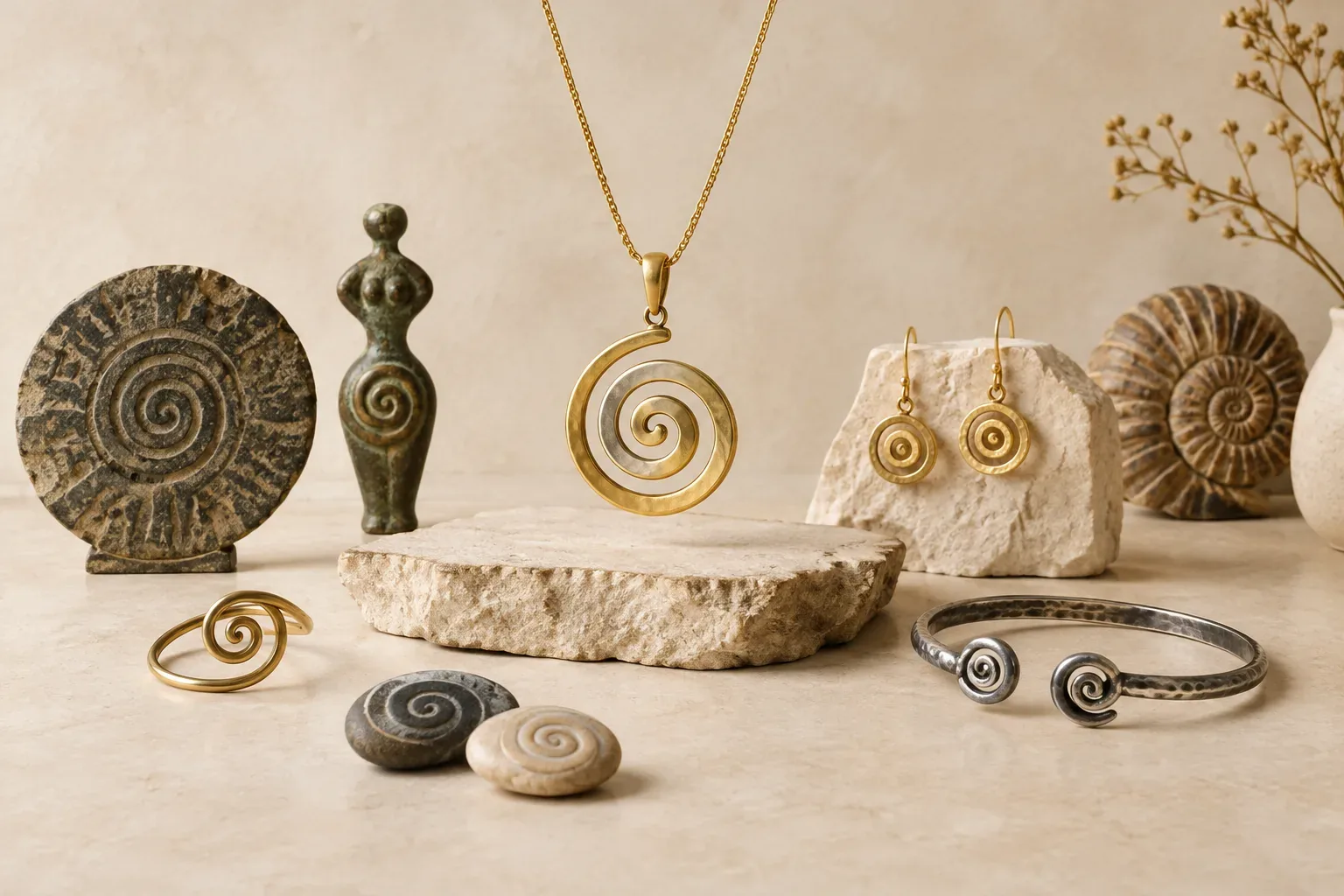
Design: Spirals appear in jewelry as linear engraving, repoussé decoration, cast or wrought metal forms, coiled wire (as in bracelets or rings), and as architectural elements in clasps, terminals and settings. Designers may echo natural spirals—the nautilus shell, scrolls of plant tendrils, or human hair coiling—or produce abstract geometric spirals.
Organic materials and gems: Shells, mother-of-pearl and other organic materials with natural coils or growth rings have long been used as pendants and inlays. Stones may be carved into spiral shapes, and gem settings can be arranged in concentric patterns. The Victoria and Albert Museum's resources on gemstones and materials describe how historic jewellers employed organic and mineral materials in ways that reflected available techniques, status and taste rather than a single coded meaning for a motif (Victoria and Albert Museum).
Modern techniques: Contemporary makers use laser-cut metals, 3D printing, and mixed materials to reinterpret the spiral. A nautilus-shaped pendant may reference natural geometry and the wearer’s intention, while a coiled cuff can signal technical virtuosity or a retro style echoing a particular historical period.
Regional practices: In some cultures a specific spiral form becomes a local emblem—such as the Celtic triskele or certain Pacific shell ornaments—where the patterned form acted as an identifiable stylistic language in brooches, torcs, pendants and hairpins. Museum descriptions typically link such designs to particular workshops, regions or periods rather than to a single fixed meaning (Victoria and Albert Museum).
Practical, respectful guidance for choosing or gifting spiral jewelry
Start with the person, not the symbol. Ask what the recipient values: craftsmanship, historical resonance, a nature motif, or a specific idea such as personal growth. If you want the piece to carry a particular message, discuss it with the giver or select a design whose contemporary symbolism aligns with the intended sentiment.
Respect cultural context. If the spiral form is clearly a culturally specific emblem (for example, a recognized Māori koru or other indigenous design), avoid treating it purely as a fashion motif without understanding its cultural and, where appropriate, spiritual significance. If you are unsure, consult reliable references, a museum or a knowledgeable jeweller, and consider buying directly from artists or communities who are the rightful custodians of that visual language.
Material and technique matter. If you prefer natural shells or particular gemstones, check their provenance and treatment. The Federal Trade Commission advises buyers to ask sellers about material treatments, imitations and disclosure; reputable retailers will provide clear information about whether a gemstone has been dyed, stabilized, reconstructed, or imitated and will supply certificates where appropriate (Federal Trade Commission).
Match scale and wearability. Spirals work as delicate motifs on a chain or as bold statement cuffs; think about the recipient’s everyday style and whether they prefer subtle or statement pieces. For gifts, consider adjustable chains or secure fastenings and choose metals and finishes compatible with the wearer’s skin sensitivity.
Document the meaning you intend. If the spiral is a gift with a specific modern meaning for you—growth, a new chapter, creativity—include a short card explaining why you chose it. Personal context helps ensure the symbol is received as intended and acknowledges that symbolic readings are often contemporary choices rather than ancient facts.
Support transparency and ethics. Ask about sourcing, hallmarks and return policies. For gemstones, insist on disclosures about treatments and, when relevant, independent grading or appraisal documentation. The FTC recommends that buyers request clear information about treatment and origins and that sellers disclose common treatments and imitations (Federal Trade Commission).
Care, authentication, and final notes
Care: Different spiral pieces need different care depending on materials. Shell pendants and organic materials typically require protection from prolonged moisture and chemical exposure; fine metals and gem settings may need professional cleaning. Ask the maker or a jeweller for specific care instructions.
Authentication: If provenance or age matters, seek documentation from the seller or an independent appraisal. Museums catalogue provenance and technical details for historic items; for purchases on the market, request clear information and certificates where appropriate.
Final note: The spiral is a versatile and long-lived motif. Its recurring presence in jewelry demonstrates aesthetic appeal and technical adaptability more than a single recorded symbolic meaning. If you value a specific symbolic reading, that modern interpretation is legitimate for your personal practice so long as you acknowledge it as contemporary and, when applicable, treat culturally specific forms with respect and due diligence.
Frequently asked questions
Does a spiral always mean rebirth or eternity?
No. While many modern sources associate spirals with ideas like rebirth or eternity, those are contemporary interpretations. Historical records compiled by museums generally show the spiral as a recurrent decorative form whose specific meanings depend on cultural context; in many cases there is no surviving explicit statement that it meant a single thing. Treat broad symbolic claims as interpretation unless supported by named historical sources (Victoria and Albert Museum).
Is it appropriate to wear culturally specific spiral designs?
Wearing a culturally specific spiral is appropriate if done respectfully. Learn the design’s origin, ask whether it has sacred meaning, and, when possible, purchase from makers within that culture. If in doubt, choose a non-specific spiral design or consult reputable sources and communities before gifting or wearing an emblem with potential religious or communal significance (Victoria and Albert Museum).
How can I be sure a spiral piece uses authentic materials?
Ask the seller about materials, provenance and any treatments. For gemstones and organic materials, request disclosure of common treatments and, when relevant, independent certification. The Federal Trade Commission recommends buyers ask for clear information on treatments and imitations and to prefer vendors who disclose such details (Federal Trade Commission).
What styles of spiral jewelry suit different wearers?
Delicate spiral pendants and small stud earrings suit those who prefer subtlety, while coiled cuffs, statement brooches or large shell pendants suit someone who likes bold pieces. Consider the recipient’s everyday wardrobe, scale preferences and whether they prefer modern, minimal, or historically inspired design before choosing a gift.
Can I give a spiral as a symbolic gift for life changes?
Yes—many people give spirals today to mark transitions, growth or new chapters. That is a meaningful contemporary choice. To ensure the gift is respectful and well received, explain your intended meaning in a note and select a design that reflects the recipient’s taste rather than assuming a historical or universal symbolism.
Sources and further reading
- Bedazzled: A History of Jewellery — Victoria and Albert Museum
- An A-Z of Gemstones — Victoria and Albert Museum
- Buying Gemstones, Diamonds, and Pearls — Federal Trade Commission