Meaning at a glance
The labyrinth motif has documented roots in historical art and architecture and has been adapted into jewelry across periods; museums record its changing contexts, while contemporary wearers attach personal meanings—this article separates documented evidence from modern interpretation and gives practical guidance for choosing, wearing, and gifting labyrinth jewelry.
Quick answer
The labyrinth motif in jewelry traces to multiple historical contexts recorded by museum scholarship and has been repurposed many times since; documented evidence notes its appearance in classical and medieval visual culture, while modern wearers commonly adopt it as a personal symbol of journey, direction, or reflection. This article explains the historical evidence (as discussed by the Victoria and Albert Museum), separates those records from later personal or popular meanings, describes how the motif and related gemstones appear in jewelry, and gives practical guidance for selecting and gifting pieces today.
What the historical record actually shows
When you want to understand the meaning of a motif such as the labyrinth, start with the documented record. Museum scholarship compiled by institutions such as the Victoria and Albert Museum sets out how motifs move between decorative art, architecture, and wearable objects. The V&A’s broad surveys of jewellery history show that decorative patterns associated with paths, mazes, and spiral designs appear in a range of cultural contexts and have been adapted by goldsmiths and lapidaries at different times for ornamental and symbolic use.
The archaeological and art-historical record includes examples where labyrinth-like patterns are integrated into ceramics, floor mosaics, and architectural ornament, and later into portable objects and personal adornment. The V&A’s histories of jewellery highlight that motifs circulating in public and sacred spaces frequently inspire designers of personal jewelry, so the presence of a labyrinth pattern in an object does not by itself prove a single, consistent meaning across time or place.
Museum literature therefore treats the labyrinth as a recurring visual form with varied uses rather than as a single symbol with a single, stable meaning. That means any historical claims about what a labyrinth 'meant' in a particular period need to be tied to that period’s own texts, contexts, and artifacts rather than to later popular explanations.
Separate documented meanings from later or modern interpretations
Documented historical meanings are those grounded in the period that produced an object: for example, when a motif appears in church architecture or liturgy in a historical period, contemporary records, theological writings, or the pattern’s placement in a sacred setting help explain how people in that time understood it. Museum accounts emphasize context—location, associated inscriptions, and how objects were used—when discussing symbolism in past cultures.
Modern interpretations, by contrast, are the meanings people attach today. Contemporary wearers and designers often treat the labyrinth as a metaphor for inner journey, perseverance, protection, or personal transformation. Those modern readings are valid as individual or cultural practices now but are not interchangeable with historical meanings unless direct evidence shows continuity. The V&A’s work on jewellery history underscores that meanings shift as objects move from public or sacred settings into private adornment and fashion.
How the motif appears in jewelry: forms, techniques, and materials
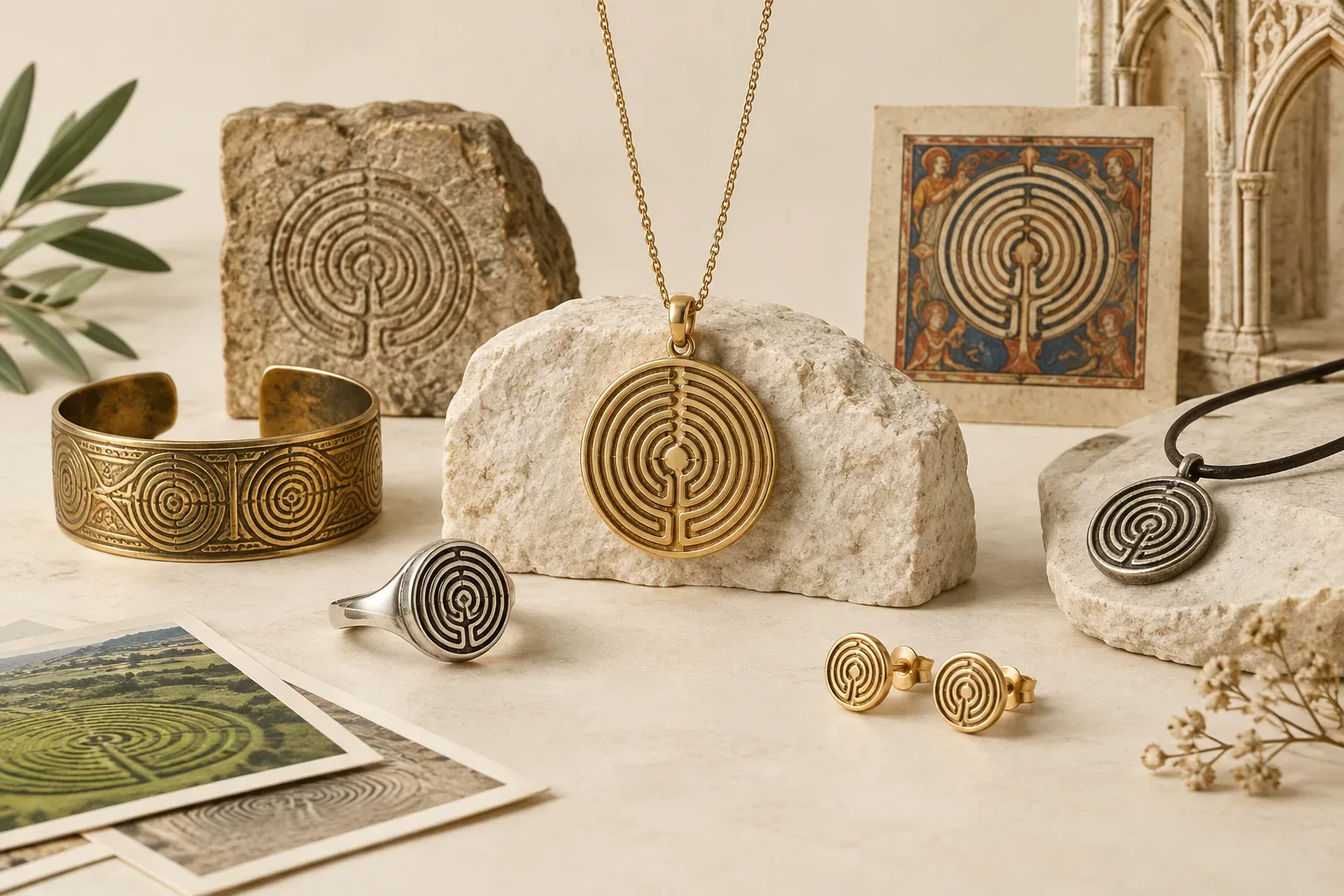
In jewelry, labyrinth motifs appear in several technical forms. Jewelers have used engraved and chased metalwork to render continuous-path patterns on pendants, lockets, and rings. Enamel has been another common technique for making clear, contrasting maze patterns, and inlaid materials such as contrasting metals or stones can emphasize the path visually on flat or slightly domed surfaces.
Gemstones and hardstones frequently serve as surfaces for carved or engraved designs. Historical lapidaries and modern makers alike employ cabochons, intaglios, and cameos to incorporate linear patterns. The Victoria and Albert Museum’s resources on gemstones describe how gem cutting and carving provide a durable field for decorative motifs; while the V&A’s general jewellery histories note that gem settings and surface ornament have long been combined to produce symbolic or ornamental effects.
Designers also translate the labyrinth into three-dimensional forms: sculpted links in chains, openwork filigree pendants, and signet-style rings whose faces incorporate the motif. Contemporary makers sometimes combine the motif with other symbols or initials to produce bespoke pieces intended to read as personal narratives rather than as fixed cultural emblems.
Gemstone considerations and material integrity
When labyrinth motifs are executed on or around gemstones, the choice of stone affects the appearance, durability, and price of the piece. The V&A’s guidance on gemstones offers historical context for common stones used in jewellery and describes treatments and cutting methods that alter a gem’s look. Stones with a smooth surface, such as onyx or agate, have historically been suitable for engraved designs, while transparent stones may be set around the motif to frame it.
If you are buying gemstone jewellery, consumer-protection guidance is important. The Federal Trade Commission provides clear advice about required disclosure of treated, synthetic, or imitation stones and recommends that buyers ask for written information about gem treatments and origin. That means if the significance of a piece depends on the stone—natural vs. treated, for example—you should request documentation and buy from a reputable dealer who will disclose treatments and replacements.
How to choose, wear, or gift labyrinth jewelry thoughtfully
Start by clarifying whether your interest is historical, aesthetic, or personal. If you want a piece that references a specific cultural or historical use of the motif, look for documentation from reputable sources and ask sellers for provenance information. Museum catalogues and reliable dealers sometimes provide comparisons to period examples and can help you identify whether a piece is a modern design inspired by historical motifs or an object produced in a recognizably traditional technique.
If your aim is symbolic or personal—giving a labyrinth pendant to represent someone’s life journey, for example—explain your intention when you gift the piece. Because the motif carries different meanings in different contexts, a short note that places the gift in the recipient’s own terms helps avoid misunderstanding and makes the symbolism explicit and respectful.
Respect cultural and religious contexts. Before gifting a labyrinth motif that might reference a sacred or communal tradition, take a moment to research whether particular forms are reserved for liturgical use or have specific local meanings. The V&A’s approach to jewellery history demonstrates how important context is to interpretation; if in doubt, err on the side of asking the recipient or choosing a clearly contemporary design that signals personal meaning rather than implied historical appropriation.
Practically, ask about materials and care. Confirm the metals and gemstones used, whether gems are treated, and what cleaning or maintenance the maker recommends. Follow the Federal Trade Commission’s advice about disclosures: request written confirmation about any treatments, synthetics, or imitations used in the piece, and keep receipts and documentation in case you need verification later.
Design ideas and situational guidance
A small, simple pendant with a geometric labyrinth can work as an everyday piece and is easy to layer with other necklaces. For formal wear, consider a recessed motif on a signet-style ring or a polished locket with a labyrinth engraved on the reverse for a private meaning. If durability and longevity are priorities, choose metals and stones that stand up to regular wear—solid precious metal settings and hard stones are practical for daily pieces.
Commissioned or bespoke pieces let you combine the motif with initials, dates, or secondary symbols to personalize the meaning. When commissioning, ask the maker about technical options—engraving into a hardstone, using enamel to keep contrasting lines crisp, or inlaying with a contrasting metal—so the motif reads clearly at the intended scale.
Final note on meaning and authenticity
Labyrinth jewellery is powerful precisely because it exists in a space between history and personal meaning. Museum scholarship such as that published by the Victoria and Albert Museum reminds us to treat historical evidence carefully and to avoid projecting contemporary meanings back onto objects without support. At the same time, modern wearers create legitimate, living traditions of meaning through personal and communal use. Choose and gift labyrinth jewellery with attention to both documented context and present-day respect.
Frequently asked questions
Does labyrinth jewelry have a single historical meaning?
No. Museum scholarship treats labyrinth motifs as recurring visual forms that change meaning with context. The Victoria and Albert Museum emphasizes that the same motif can serve different functions in architecture, public art, and personal adornment, so a single universal historical meaning cannot be assumed.
Can labyrinth jewelry be a religious symbol?
Sometimes. In historical contexts where a labyrinth appears in a sacred space, it may carry religious meaning specific to that tradition and period. Contemporary pieces that borrow the motif are not automatically religious; whether a piece is religious depends on its provenance, use, and the wearer's intention.
What should I ask when buying a labyrinth piece with gemstones?
Ask the seller for written details about the metals and gems used, including any treatments, whether stones are natural, synthetic, or imitations, and provenance documentation if available. The Federal Trade Commission recommends getting disclosure of treatments or imitations in writing and buying from a reputable dealer.
Is it respectful to gift labyrinth jewelry to someone from another culture?
Exercise care and curiosity. Research whether the particular labyrinth form has contemporary sacred or communal significance, and consider discussing your intention with the recipient. If you are unsure, choose a design presented explicitly as a contemporary interpretation.
How can I preserve detailed labyrinth engraving or enamel in a piece?
Select durable materials and appropriate settings. Hard stones, solid metal backings, and protective bezels help retain fine engravings and enamel work. Follow maker-recommended cleaning and storage instructions to avoid abrasion and chemical damage.
Sources and further reading
- Bedazzled: A History of Jewellery — Victoria and Albert Museum
- An A-Z of Gemstones — Victoria and Albert Museum
- Buying Gemstones, Diamonds, and Pearls — Federal Trade Commission