Meaning at a glance
Elephant jewelry meaning: this article explains the documented history and changing contexts of the elephant motif, separates cultural or religious evidence from later popular interpretations, and gives practical guidance for choosing and wearing the motif in modern jewelry.
What the historical evidence shows
Museum collections and catalogues record the elephant motif in objects from a range of regions and periods. Curators at the Victoria and Albert Museum describe how jewellery and related decorative arts change function and meaning as they move between contexts; the V&A’s material highlights examples from South Asia, Southeast Asia, Africa and Europe where elephant imagery appears in everything from metalwork and carved inlay to pomp and pageant regalia and small personal ornaments (Victoria and Albert Museum).
These museum records are documentary evidence of use: elephants were reproduced in durable materials and portable media used as personal adornment or display. That pattern — motif used across regions and adapted to new tastes — is the type of historical trajectory the V&A traces in its treatment of jewellery history and changing social contexts (Victoria and Albert Museum).
Separate documented historical meanings from later interpretations
Documented historical meanings are what museum object records, makers’ notes and provenance indicate about how a piece was used. The V&A’s work on jewellery history shows that motifs including animals could act as markers of status, identify the wearer’s link to a court or household, serve as amulets or protective tokens in specific social contexts, or be purely decorative in luxury trade objects (Victoria and Albert Museum). Those uses are supported by object history and curatorial description.
Modern, widely reported interpretations — for example, that elephant jewellery universally means luck, wisdom, or fertility — are contemporary, often personal readings rather than single historical facts. Such meanings are popular and meaningful for many wearers today, but they are not universal and are not a substitute for documented cultural or religious contexts. Treat modern symbolic claims as expressions of personal or commercial meaning unless a museum catalogue or a primary cultural source documents a particular religious or ritual significance for an identifiable object or community.
How the elephant motif and related materials appear in jewellery
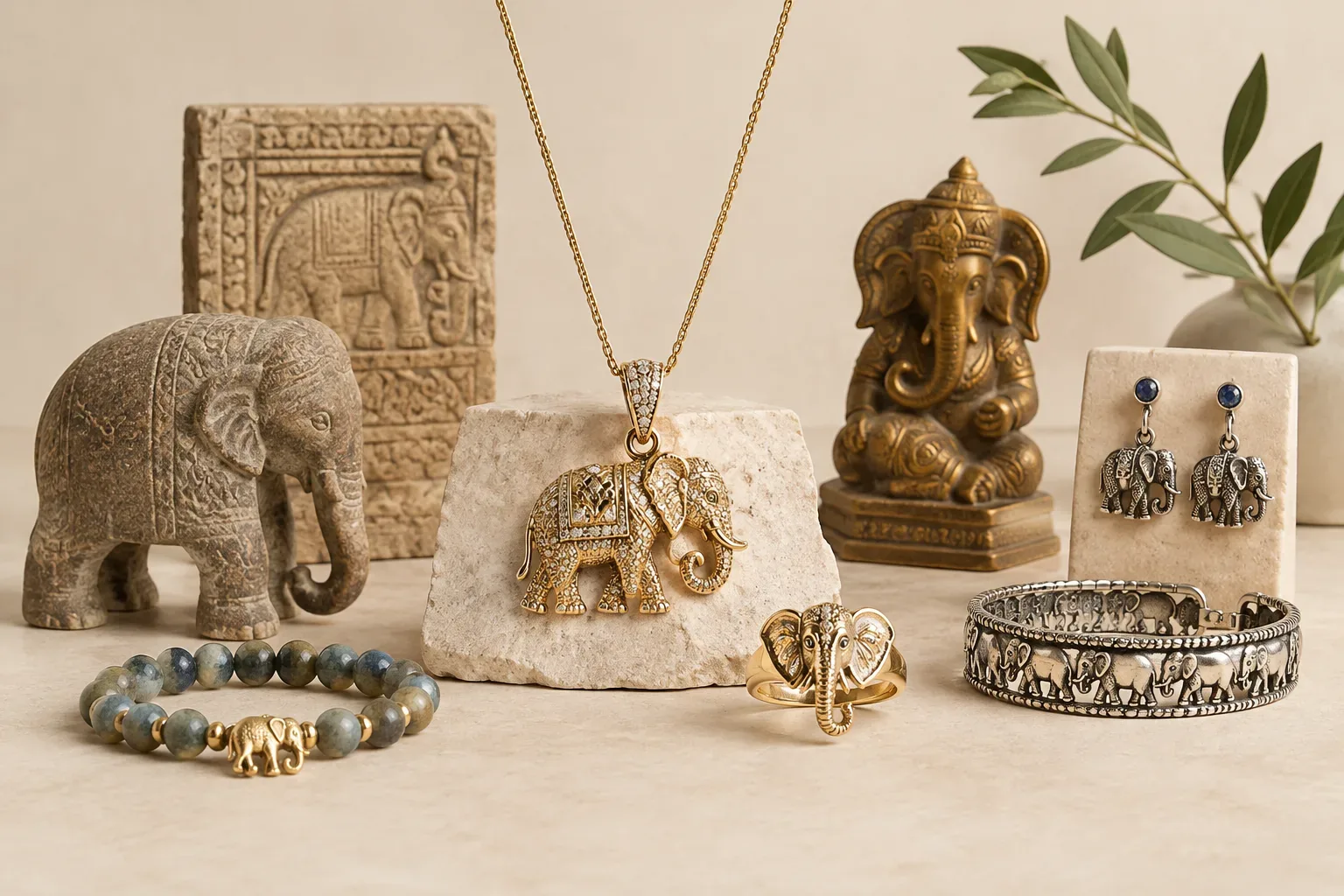
The elephant motif appears in jewellery in many forms: small carved pendants and beads, enamelled brooches and lockets, gem-set figurative pendants, engraved metalwork on bangles and rings, and as decorative elements on larger items such as belts or ceremonial regalia. Museum records show craftsmen used local techniques and materials to render the motif, adapting scale and ornament to the object’s function (Victoria and Albert Museum).
Materials matter. Historically and today, elephant motifs have been executed in precious metals, carved organic materials and gemstones. The Victoria and Albert Museum’s overview of gemstones explains how different stones and settings travelled with trade and fashion, shaping the visual vocabulary of jewellery across regions. In modern pieces you will also find crystal, enamel, plated metals and manufactured imitations used to produce cost-effective versions of popular motifs (Victoria and Albert Museum).
When buying gem-set elephant jewellery, remember that gemstones are often treated, enhanced, or simulated. The Federal Trade Commission recommends that sellers disclose treatments and imitations and that buyers ask for information about origin, treatment, and care (Federal Trade Commission).
Selecting or gifting elephant jewellery: practical and respectful guidance
Check materials and provenance. If a piece includes carved ivory or other regulated wildlife materials it may be illegal to buy or import; ask the seller about material origin and documentation. Prefer responsibly sourced metals and gems, and request clear disclosure of any treatments or simulants, in line with FTC guidance (Federal Trade Commission).
Consider the recipient’s cultural or religious commitments. Some communities attach specific ritual or sacred value to elephant imagery; others use it stylistically. If you are unsure whether a particular symbol might be sensitive to the recipient, ask discreetly or choose a neutral alternative design. Framing the gift as a personal and thoughtful symbol — for example, selecting an engraved message or a design that references a private memory — reduces the risk of unintended offence.
Match scale and context. A delicate silver elephant pendant works well for everyday wear and as a subtle symbolic gift. Larger, heavily bejeweled pieces read as statement jewellery or ceremonial dressing. Think about the recipient’s wardrobe and lifestyle when selecting metal, finish and size.
Verify gemstones and treatments. For gem-set pieces, request written information about the stone, any heat or dye treatments, and whether it is a natural stone, synthetic, or imitation. The FTC recommends transparency from sellers about such treatments (Federal Trade Commission).
Care and longevity. Precious metals and gemstones require different care than plated or composite pieces. Ask the seller for care instructions and consider an appraisal or condition report for valuable items. For sentimental gifts, consider pairing the piece with a short note explaining why you chose the motif and what it means to you — that personal context is often as important as the symbol itself.
Wearing elephant jewellery respectfully and stylishly
Use the motif thoughtfully. Wearing elephant jewellery as a personal reminder — for example, of patience or family ties — is a legitimate, contemporary choice. Keep in mind that the way a motif is perceived depends on scale, materials, and the cultural context of wear.
Layer and combine with care. A small elephant charm pairs well with fine chains and minimalist stacks; bolder carved or enameled figures work better as focal points. Respect traditional techniques by supporting makers who use appropriate skills and materials rather than mass-produced imitation versions where ethical or legal risks are present.
If your piece draws on a specific cultural style or technique, consider learning about that tradition and acknowledging it when you wear or gift the item. That awareness makes the jewellery more meaningful and demonstrates respect for the makers and cultures that shaped the motif.
Closing note
Elephant jewellery meaning is best understood as a tapestry of documented uses and evolving personal interpretations. Use museum scholarship and seller disclosures to ground decisions about authenticity and provenance, and pair that factual grounding with respectful attention to the cultural significance a motif may have for the wearer.
Frequently asked questions
Does elephant jewelry always mean good luck?
No. While many modern wearers and sellers describe elephant jewellery as symbolizing luck, wisdom or protection, those are contemporary, popular interpretations. Museum documentation shows elephants have been used for multiple purposes historically — decorative, status or protective — but meanings vary by object, culture and time.
Is it okay to wear elephant imagery if I don't belong to the culture it comes from?
Wearing elephant jewellery is not inherently inappropriate, but be mindful. If the piece clearly references a living religious tradition or ritual use, check with the recipient or learn about the context before gifting or wearing it casually. Choosing work by makers who acknowledge their sources and using the piece respectfully reduces the risk of offence.
Can I buy elephant carvings made from ivory?
Many countries restrict trade in ivory. Ask sellers about material origin and legal documentation before purchase. Prefer legally sourced, contemporary alternatives and certified materials; museum and conservation rules increasingly prohibit trade in traditional ivory.
How can I verify a gemstone in an elephant pendant?
Request written disclosure from the seller about the stone’s identity, any treatments, and whether it is natural, synthetic, or an imitation. The Federal Trade Commission recommends transparency on treatments and origin; for valuable stones, seek an independent gemological report.
What metals and finishes work best for daily wear?
For everyday pieces choose durable metals such as sterling silver, gold or plated options with good backing and protective finishes. Consider the wearer’s sensitivity to metals and the expected wear conditions when picking finish and scale.
How can I make an elephant jewellery gift feel personal?
Consider adding an engraved message, choosing a motif style that connects to a shared memory, or selecting a piece whose materials and craftsmanship reflect the recipient’s taste. A brief note explaining why you chose the motif often makes the gift more meaningful.
Sources and further reading
- Bedazzled: A History of Jewellery — Victoria and Albert Museum
- An A-Z of Gemstones — Victoria and Albert Museum
- Buying Gemstones, Diamonds, and Pearls — Federal Trade Commission