Meaning at a glance
Owl jewelry meaning combines a long visual history as an animal motif with shifting cultural interpretations; museum evidence shows motifs evolve with technique and taste, while modern wearers add personal layers of meaning—choose materials, makers, and gemstones with care and be mindful of cultural context and disclosure on treatments.
What the historical evidence actually shows
Collections, exhibition catalogues, and museum research are the primary sources for claims about the past, because they record objects, makers, materials, and provenance. The Victoria and Albert Museum situates jewellery motifs inside changing social and technological contexts and documents how animal forms recur across different periods as techniques and fashions shift.
Museum records make two consistent points relevant to the owl motif: first, animal motifs are a recurring visual vocabulary in jewellery across many periods; second, the meaning attached to a motif often changes with cultural context, patronage, technique, and fashion. That evidence is object-based and interpretive, and the Victoria and Albert Museum presents it as evolving rather than universal.
When authors or dealers assert that the owl had a single religious or civic meaning in a given historical culture, check whether they cite archaeological finds or museum cataloguing. Museum documentation typically identifies where and when an object was made, the materials and techniques used, and the contexts in which it was worn or displayed, and it warns against projecting later meanings back onto older objects.
Historical periods and contexts where owl motifs appear
Archaeological and museum collections show animal motifs, including birds, throughout antiquity and later periods, and curators at institutions such as the Victoria and Albert Museum trace how motifs reappear with new materials and functions. The surviving evidence tends to be object-centred: engraved gems, metalwork, enamelled pieces, and later European jewellery where animal imagery is visible in design and technique.
In later historic periods represented in museum collections, such as the 19th-century revival styles and early 20th-century decorative arts, animal motifs were often deployed for fashion and symbolism within particular social trends. The Victoria and Albert Museum describes how changes in taste and technique produced new ways to render animals in metal, enamel, and stone, which helps explain why owl designs vary markedly between periods and makers.
Modern museum displays also show the growth of costume and novelty jewellery in the 20th century, when accessible materials and mass production made animal motifs widely available to the buying public. That change altered how motifs functioned: moving from objects with specific civic or ritual roles to fashion accessories that could carry a range of personal meanings.
Separating documented historical meanings from modern interpretations
Documented historical meanings are the associations that contemporaneous sources, makers' records, or reliable provenance link to an object. Museum scholarship establishes those meanings where evidence exists and otherwise notes ambiguity. The Victoria and Albert Museum emphasizes that motifs acquire particular functions and meanings when supported by context such as inscriptions, burial associations, or documentary references, and that without such context, interpretation should be cautious.
Modern personal interpretations are contemporary layers of meaning people attach to motifs today. Popular ideas about owls—wisdom, intelligence, nocturnal mystery, or protection—are largely modern and cultural rather than universally historic. These associations may draw on literature, modern media, or recent decorative traditions rather than directly on object-level evidence from earlier periods.
When evaluating the meaning of a particular historic owl piece, ask whether curators assign it a function or meaning based on provenance and documentation, or whether they present the motif as part of a broader decorative vocabulary. Where museums present both object information and interpretation, such as the Victoria and Albert Museum's work on jewellery history, follow the evidence trail rather than assuming a single symbolic meaning.
How the owl motif, gemstones, and techniques appear in jewellery
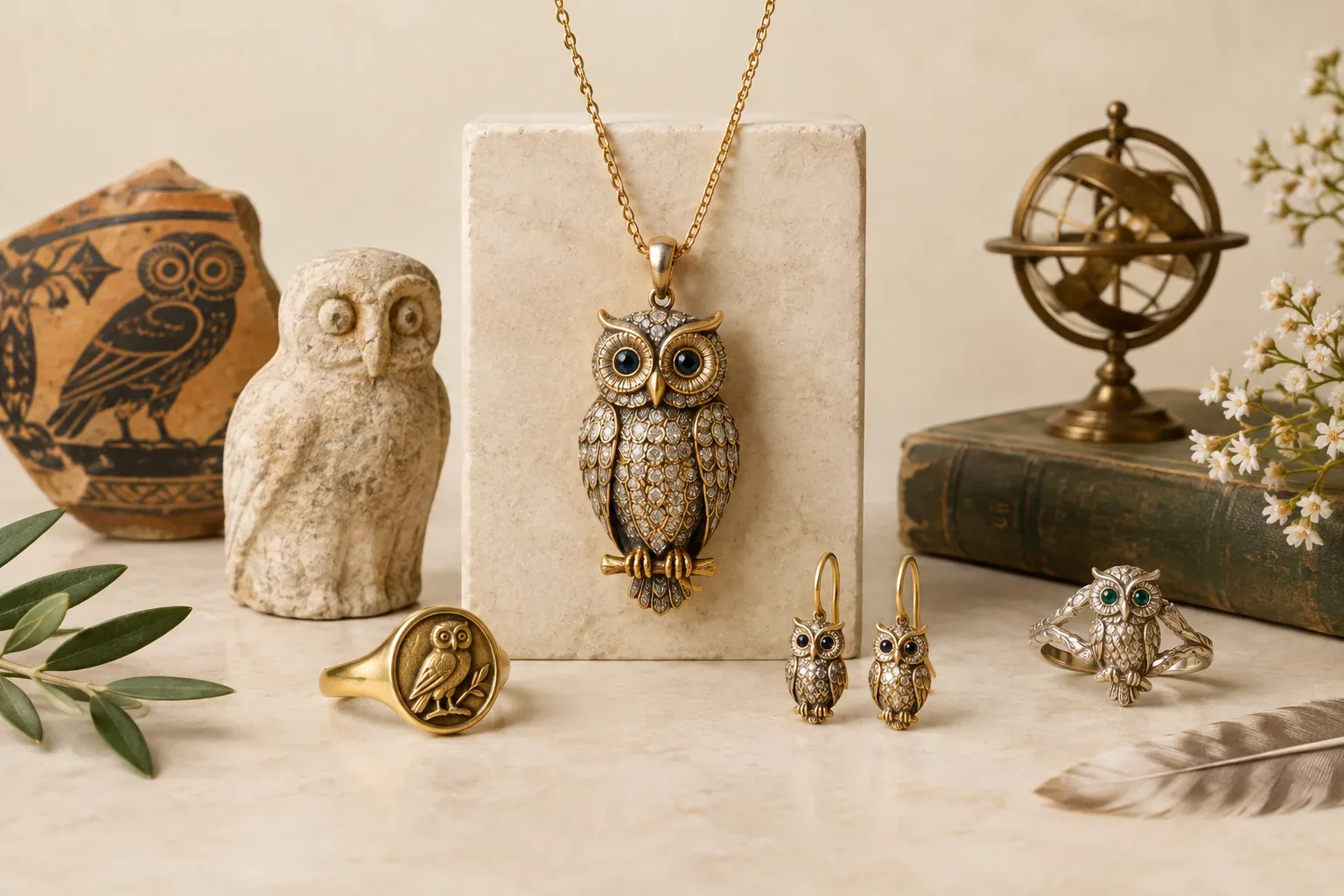
The owl motif appears in jewellery in many ways: as a fully modelled animal in metal, as a stylized silhouette worked into pendants and brooches, as an engraved or inlaid motif on lockets and bands, and as a motif enlivened by enamel, stones, or glass. Museum collections and catalogues show that makers choose technique and material to suit the motif and the prevailing aesthetic of the period, and the Victoria and Albert Museum illustrates these technical variations across its collections.
Gemstones and glass are used to animate owl features such as eyes and body. Curatorial and gemological resources demonstrate that designers use faceted stones for sparkle, cabochons for a rounded effect, and enamel for colour and texture. The Victoria and Albert Museum’s articles on gemstones explain how different stones and settings have been used historically and how artisans' technical advances broadened decorative possibilities.
Because treatments, imitations, and assembled materials became widespread in the jewellery market, it is important to check disclosures. The Federal Trade Commission advises buyers that sellers should disclose treatments, synthetics, and imitations when they affect value or appearance, and it offers practical guidance for asking about origin, treatment, and certification before purchase.
Practical guidance for selecting or gifting owl jewellery
Start from the wearer’s preferences rather than assuming a single symbolic meaning. Consider whether the recipient prefers subtle, stylized pieces or bold, naturalistic animals, and choose scale, metal, and finish accordingly. If the piece is intended as a symbol, discuss what the motif means to the recipient to ensure the gift communicates as you intend.
Respect cultural sensitivity and provenance. Avoid asserting ancient or sacred meanings without evidence, and when buying historic or museum‑quality pieces, ask for provenance and documentation. The Victoria and Albert Museum recommends relying on museum and specialist knowledge to understand an object’s context, and the same caution applies when acquiring reputedly historic pieces in the market.
When gemstones or valued materials are involved, ask the seller for clear information on material origin and treatments. The Federal Trade Commission recommends that buyers request written disclosure of heating, dyeing, filling, or synthetic origin for gemstones and diamonds, and that purchasers look for reputable testing or certification where value is significant.
If you prefer contemporary ethical production, ask makers about their materials and workshop practices. For everyday wear, consider durable settings, protective finishes, and stones less prone to surface damage. For heirloom or investment pieces, prioritize documented authenticity and a professional appraisal.
Care, authentication, and documentation
Keep basic care in mind: soft stones and enamels require gentle cleaning and storage separate from abrasive items, while more durable metals and faceted gems tolerate daily wear better. Museum care notes and the V&A’s jewellery narratives highlight how conservation needs depend on materials and historical construction.
For authentication, provenance and documentation are crucial. Museum cataloguing practices emphasise recording maker marks, hallmarks, and documented ownership when available, and buyers should ask for similar information from dealers. Where gemstones are claimed to be natural, the Federal Trade Commission advises obtaining disclosure about treatments and, for higher‑value stones, independent gemological reports.
Finally, conserve the story as well as the object. Whether you buy new or historic, record what you were told about the piece and keep receipts and any certification, because the social meaning of jewellery often accrues through ownership and stories as much as through original maker intent.
Conclusion
Owl jewellery meaning is best understood as a combination of documented visual history and contemporary interpretation. Museum evidence, as presented by institutions such as the Victoria and Albert Museum, shows that the motif has reappeared in different materials and styles across periods, and that its specific meanings should be tied to documented context rather than assumed. Today, wearers freely add personal layers of meaning, and sensible buying practices informed by the Federal Trade Commission’s advice on gemstones and disclosure will help you choose pieces that are both meaningful and trustworthy.
Frequently asked questions
What does owl jewelry traditionally symbolize?
Traditionally, the meaning of any motif depends on context and documentation. Museum scholarship, as represented by the Victoria and Albert Museum, shows that animal motifs reappear in different periods and that their specific symbolic roles should be established from object‑level evidence. Many contemporary meanings attributed to owls, such as wisdom or mystery, are modern cultural associations rather than universally documented historical facts.
Is it appropriate to gift owl jewellery for someone interested in symbolism?
Yes, if you have discussed the intended meaning with the recipient and chosen a style that fits their taste. Be careful about asserting an ancient or sacred meaning unless the piece’s provenance supports that claim. For advice on choosing meaningful jewellery, consult specialist guides and consider the wearer’s personal associations with the motif.
How can I tell whether the stones in owl jewellery are real or treated?
Ask the seller for written disclosure about gemstone treatments, synthetics, or imitations. The Federal Trade Commission recommends requesting information about heating, dyeing, filling, or synthetic origin, and seeking independent gemological certification for higher‑value stones.
Are owl motifs more common in fine jewellery or costume jewellery?
Museum collections and market history show both fine and costume jewellery use animal motifs. The form appears across techniques from high‑end metalwork and gemstone settings to accessible enamel and glass costume pieces, reflecting how fashion, technology, and price shape decorative choices.
How should I care for an owl pendant with enamel or delicate stones?
Treat enamel and soft stones gently: avoid ultrasonic cleaners, keep the piece away from harsh chemicals, clean with a soft cloth and mild soap when needed, and store it separately to prevent scratches. When in doubt, follow the care guidance supplied by the maker or consult a jewellery conservator for historic pieces.
Sources and further reading
- Bedazzled: A History of Jewellery — Victoria and Albert Museum
- An A-Z of Gemstones — Victoria and Albert Museum
- Buying Gemstones, Diamonds, and Pearls — Federal Trade Commission