Meaning at a glance
Explain the documented history and changing contexts of the spider motif, separate cultural or religious evidence from later popular interpretations, and give practical guidance for choosing and wearing the motif in modern jewelry.
Historical evidence and where it comes from
Major museum surveys of jewelry history emphasize that decorative motifs and the materials used to make them change with social tastes and technology. The Victoria and Albert Museum’s overview of jewellery history documents the broad patterns in which designers have borrowed from nature and the surrounding world, and it places animal and natural motifs within shifting stylistic movements and social contexts rather than a single symbolic system.
In practice, that means that surviving jewelry pieces featuring insects, arachnids, and other small creatures most often reflect the materials available to the maker, popular fashions, and the cultural interests of a period. For example, late 19th- and early 20th-century European jewellery often drew on natural history and botanical sources as stylistic inspiration; museum collections discussed by the Victoria and Albert Museum show how natural motifs were rendered in enamel, carved gemstones, and metalwork during those years.
The museum also documents specific material trends that influenced how motifs were executed. Victorian-era tastes included the use of black materials such as jet and onyx in mourning jewellery, and makers used techniques such as enamelwork, gem carving, and setting small stones to create lifelike animal and insect details. Those technical and stylistic notes establish the contexts in which a spider motif might appear, but they do not support a single, uniform symbolic meaning across cultures or centuries.
Documented historical meanings versus later interpretations
When we look for historically documented meanings attached to the spider motif, the museum-level evidence points to context-specific meanings rather than a single ancient or universal symbol. Institutional collections and exhibition narratives (as summarized by the Victoria and Albert Museum) tend to link motifs to style, status, and taste—what a motif signified depended on where and when it was made and who commissioned or wore it.
That differs from many modern interpretations. Today, people often assign personal or popular-cultural meanings to spider jewelry: creativity and craftsmanship (a parallel to a spider’s web), resilience and patience, feminine power, protection, or a Gothic or Halloween sensibility. These contemporary readings can be meaningful for wearers and gift-givers, but they are modern attributions and should be presented as personal or cultural interpretation rather than fixed historical fact.
How the spider motif, gemstones, and traditions appear in jewelry
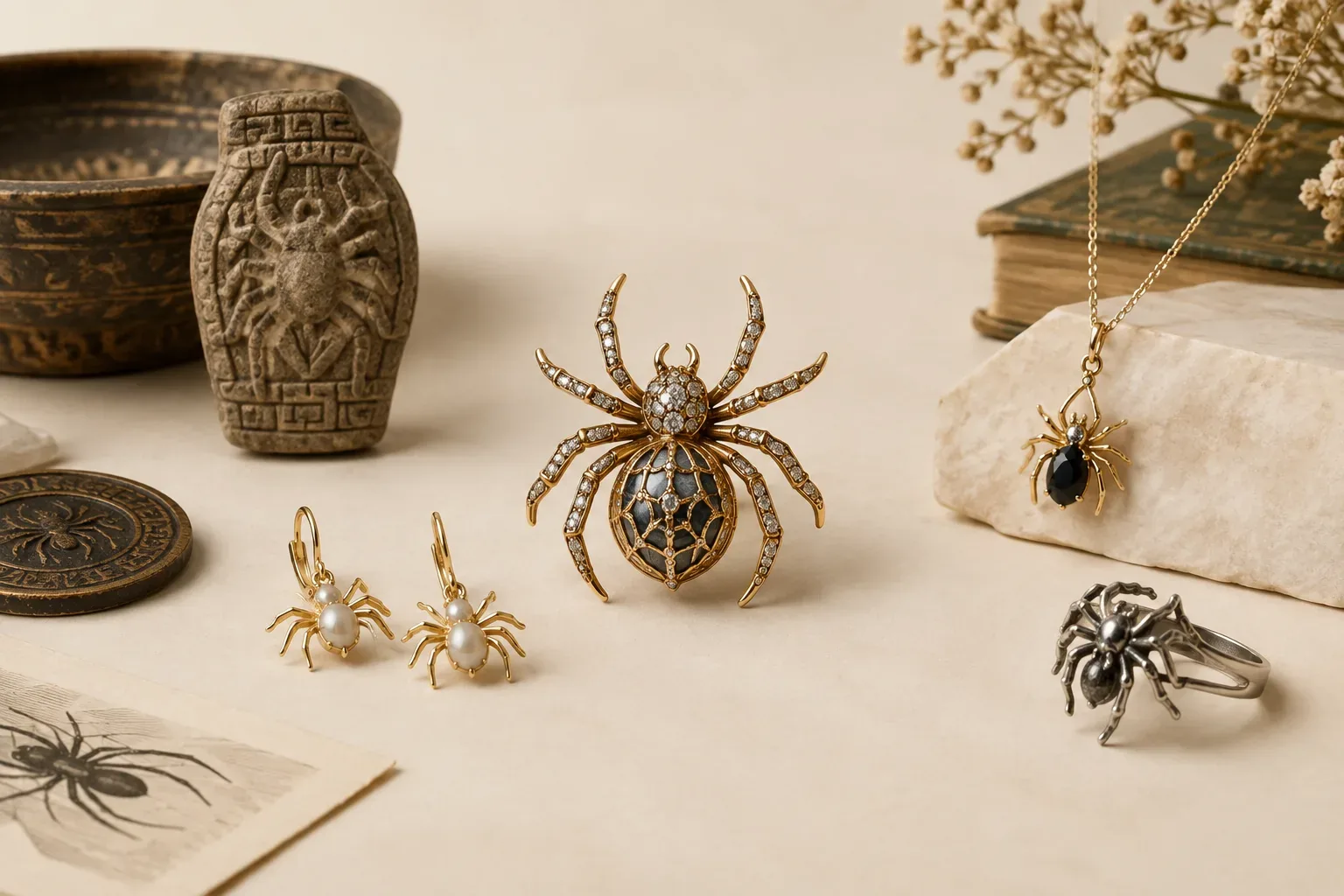
Technically, the spider motif appears in jewelry through the same range of techniques used for other figural and natural subjects. Enamel is often used to add color and surface detail, while small faceted stones or cabochons give sparkle or form "eyes." Metalwork—cutout silhouettes, pierced silver, gold filigree, and cast settings—creates the body and legs. The Victoria and Albert Museum’s materials on jewellery history illustrate how makers have used such techniques to render animals and insects with convincing detail.
Materials associated with certain historical traditions are also relevant. The V&A documents the Victorian use of black materials for mourning jewellery and the wider interest in natural motifs during the 19th century; consequently, period pieces with a spider motif might be executed in jet, onyx, enamel, or silver and sometimes combined with seed pearls or small garnets to animate the design. In modern production, designers may use mixed metals, oxidized finishes, and contemporary gemstones or synthetics to achieve a particular aesthetic.
Gemstone choice for a spider motif follows the same practical and aesthetic principles used elsewhere in jewellery. Brightly colored stones or enamels can emphasize a stylized or playful design, while dark stones and subdued metals produce a more sombre or Gothic effect. When buying gemstones, be aware that treatments, enhancements, and imitations are common; federal guidance recommends asking sellers about any treatments and requiring clear disclosure when applicable (see the Federal Trade Commission’s consumer guidance).
Practical guidance for selecting or gifting spider jewelry
Begin with intent: decide whether the gift is intended as a fashion statement, a symbol with a personal meaning for the recipient, a historical or vintage collectible, or a novelty item for seasonal wear. Knowing the occasion and recipient’s tastes will guide choices in scale, realism, and materials.
Consider cultural and personal sensitivity. Not everyone appreciates spider imagery: some people have arachnophobia, while others may attach religious or cultural meanings to spiders that differ from modern Western readings. If you are unsure, ask discreetly or choose a subtler motif—an abstract web pattern, a small charm, or a stylized spider outline can be less confrontational than a large, life-like brooch.
Check materials and disclosures. If gemstones or antiquities are involved, ask the seller about gemstone treatments, imitations, and provenance. The Federal Trade Commission’s guidance for consumers of gemstones and pearls recommends obtaining clear information about whether stones are treated, lab-grown, or imitations and getting purchase documentation when available.
Match scale and setting to lifestyle. A delicate pendant or ring might suit everyday wear; a larger brooch or statement piece is more seasonal or occasion-based. Consider metal allergies and the recipient’s typical wardrobe. If the piece is vintage or antique, plan for secure settings and professional inspection to ensure stones and mounts are sound.
When gifting a historically styled or antique piece, include context. If the piece has documentary value or is a reproduction of a historic style, a note explaining the design’s provenance or the era it evokes helps the recipient appreciate the object without assuming a single meaning.
Caring for spider-themed jewelry
Care follows the materials. Silver, gold, enamel, carved stones, and delicate pavé-set gems each require different handling and storage. Keep pieces away from harsh chemicals, and store fragile or intricately jointed items separately to avoid tangling or crushing fine legs and settings.
If you purchase or inherit a vintage spider piece, consult a qualified jeweller for cleaning and any necessary repairs. For gemstones, ask the seller about care recommendations suited to the specific stones and finishes in the piece; if the seller cannot provide clear guidance or disclosure about treatments, consider seeking a second opinion before purchasing.
Final note on use and meaning
Museums such as the Victoria and Albert Museum emphasise that jewellery’s meanings are historically and culturally situated; the spider motif’s significance therefore depends on maker intention, materials, and the wearer’s interpretation. Modern personal meanings are legitimate—resilience, creativity, protection, and identity are common contemporary readings—but they are not direct replacements for careful provenance-based interpretation when assessing older pieces.
Frequently asked questions
Does spider jewelry have a single historical meaning?
No. Museum-level evidence indicates there is no single historical meaning for the spider motif. The Victoria and Albert Museum emphasizes that motifs vary with time, place, maker intention, and fashion. Where a spider appears in historic jewellery, its significance must be interpreted within that specific context rather than assumed universal meaning.
Are spiders common in Victorian jewellery?
Victorian jewellery frequently used natural motifs and employed materials such as jet and onyx for mourning pieces, as documented by the Victoria and Albert Museum. That era’s interest in natural history made insects and small creatures popular subjects, but the presence of a spider on a Victorian piece reflects stylistic taste and materials rather than a single standard symbolism.
What modern meanings do people attach to spider jewellery?
Contemporary wearers often attribute personal meanings such as creativity, patience, resilience, protection, feminine power, or a Gothic aesthetic to spider designs. These are modern interpretations and are meaningful to individuals or groups, but they should not be conflated with historically documented symbolism.
How can I be sure about the gemstones in a spider-themed piece?
Ask the seller about stone identity, any treatments, and whether stones are natural, lab-grown, or imitations. The Federal Trade Commission recommends clear disclosure of treatments and enhancements; request written confirmation when possible and consult an independent gemological opinion for high-value items.
Is spider jewellery appropriate as a gift?
It can be appropriate if you consider the recipient’s tastes, cultural background, and possible fears. Choose scale and realism with care: subtle or stylized designs are safer for broad audiences, while realistic statement pieces suit recipients who appreciate bold or Gothic aesthetics. Include context about the design if the piece has historical roots or distinctive symbolism.
Sources and further reading
- Bedazzled: A History of Jewellery — Victoria and Albert Museum
- An A-Z of Gemstones — Victoria and Albert Museum
- Buying Gemstones, Diamonds, and Pearls — Federal Trade Commission